

November is when Colorado's birds change shifts. A lot of the summer crowd has gone south, and a different group arrives from the north, for whom the Front Range is a mild place to spend the winter. You don't need a feeder or a spotting scope to see them. A walk along a reservoir, a field edge or a trail through junipers is enough, as long as you know what you're looking at.
Here are five worth looking for right now, and the details that tell each one apart.
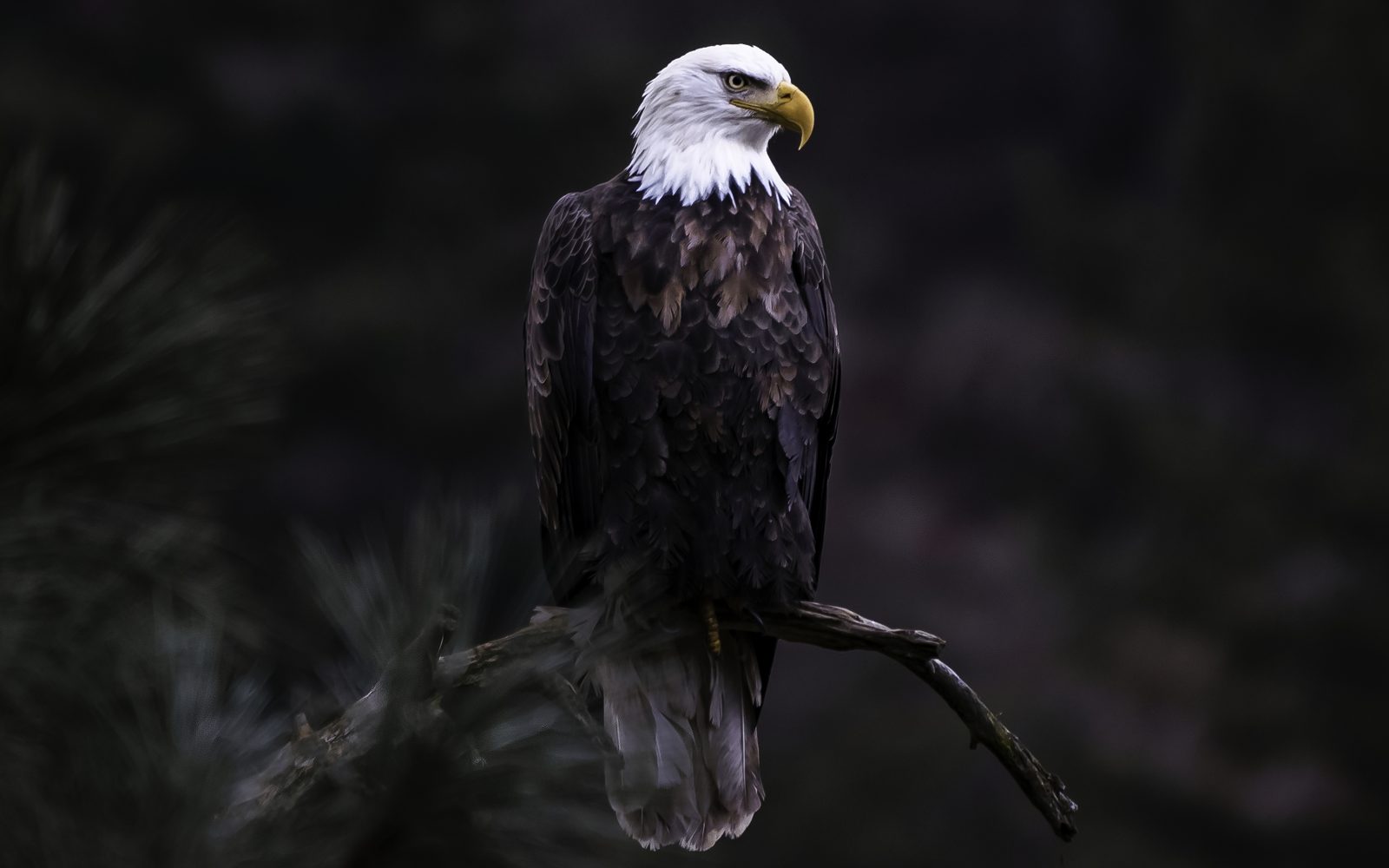
1. Bald eagle
Colorado has a few hundred resident nesting pairs, but winter brings visitors from farther north, and the number of bald eagles in the state climbs past a thousand. In Fort Collins, the city's Natural Areas team says the wintering eagles show up in late November and start heading north again from mid-February into March.
Where to look: open water. Reservoirs and rivers that haven't frozen over, and the big cottonwoods along their shores, where eagles perch and watch for fish and ducks. Fossil Creek Reservoir in Fort Collins, Barr Lake State Park near Brighton and Lake Pueblo State Park are reliable spots.
How to tell: an adult is hard to mistake, with its white head and white tail. Young eagles are a different story: they're mottled brown for their first few years, and a lot of people take them for a large hawk. Size is the giveaway. A bald eagle's wings are far longer than any hawk's, and it soars with them held flat, like a plank.
2. Rough-legged hawk
This one spends the summer on the Arctic tundra and comes south when the snow covers it. In Colorado it rarely shows up before November or stays past early April, and how many arrive changes a lot from one winter to the next.
Where to look: wide-open country. Fields, grassland and prairie, often on a fence post, a utility pole or a thin branch at the top of a tree.
How to tell: watch how it hunts. Rough-legged hawks hover in the wind over a field far more than other hawks do, wings working, head pointed down. From below, look for dark patches at the bend of each wing (the "wrists"), a white tail with a dark band at the tip, and often a dark band across the belly. The name comes from its legs, which are feathered all the way to the toes. The red-tailed hawk is the one most people confuse it with: red-tails have broader wings and lack those big dark wrist patches.
3. Dark-eyed junco
If a small gray bird is hopping around under your bushes this month, it's very likely a junco. When it flies off, it flashes white feathers on both sides of its tail, which is the easiest way to know.
Juncos come in several regional forms, and Colorado gets a mix. The gray-headed junco is the only form that nests in the state, mostly up in the mountains. In winter, the slate-colored and Oregon forms are the most common ones in the lowlands, and the mountain birds move down too.
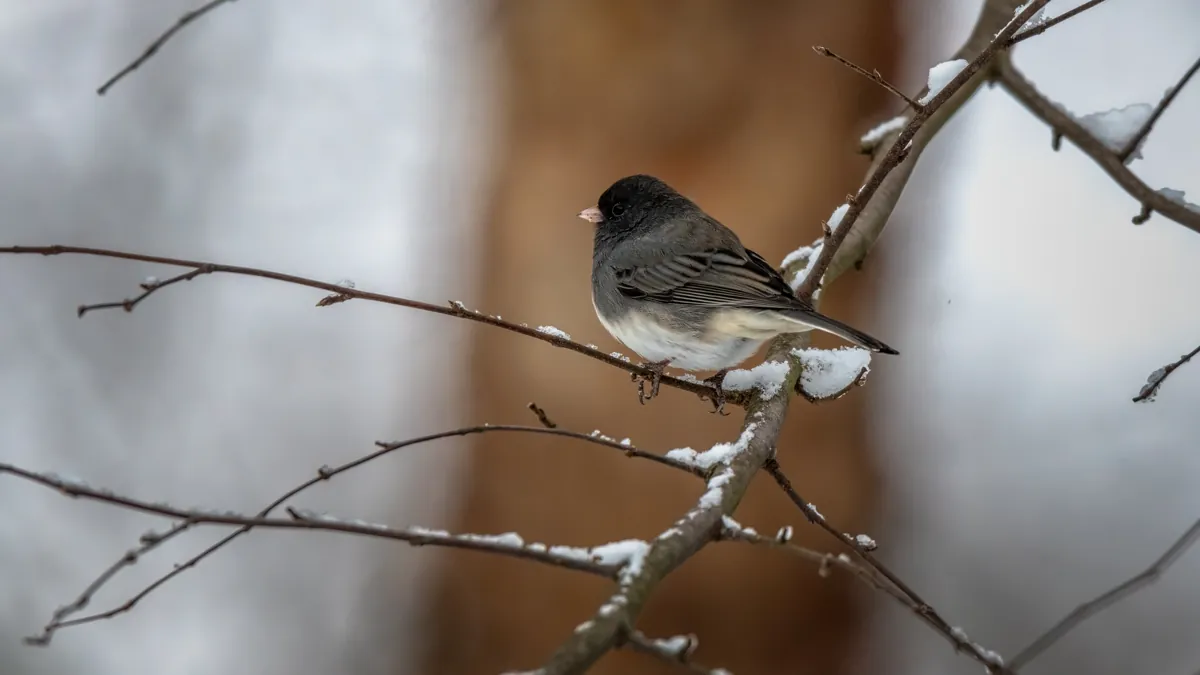
How to tell the forms apart:
- Gray-headed: pale gray head and gray sides, with a rusty patch on the back.
- Oregon: a dark hood, a brown back and warm pinkish-brown sides.
- Slate-colored: gray all over on top with a clean white belly.
They're ground feeders, so look down: under shrubs, along trail edges and below feeders. Listen for a sharp, short "dit" call.
4. Townsend's solitaire
Here's a bird that behaves strangely for winter. A slim gray thrush sits alone at the very top of a juniper or a dead snag and sings, in November, when almost nothing else does.
It's guarding food. In winter, Townsend's solitaires live mostly on juniper berries, and each bird claims a patch of junipers and defends it against other solitaires (and tries to chase off robins). Rocky Mountain National Park notes that the birds with the richest berry territories are more likely to make it through the winter, so the singing is serious business.
Where to look: juniper country in the foothills, and sometimes big junipers in town.
How to tell: plain gray with a white eye-ring, long tail, and pale buff patches in the wings that show when it flies. The upright posture on a high perch is often the first clue.
5. American tree sparrow
Despite the name, you'll usually find this sparrow on the ground, often in small flocks and often mixed in with juncos. It nests far to the north and is a winter visitor here.
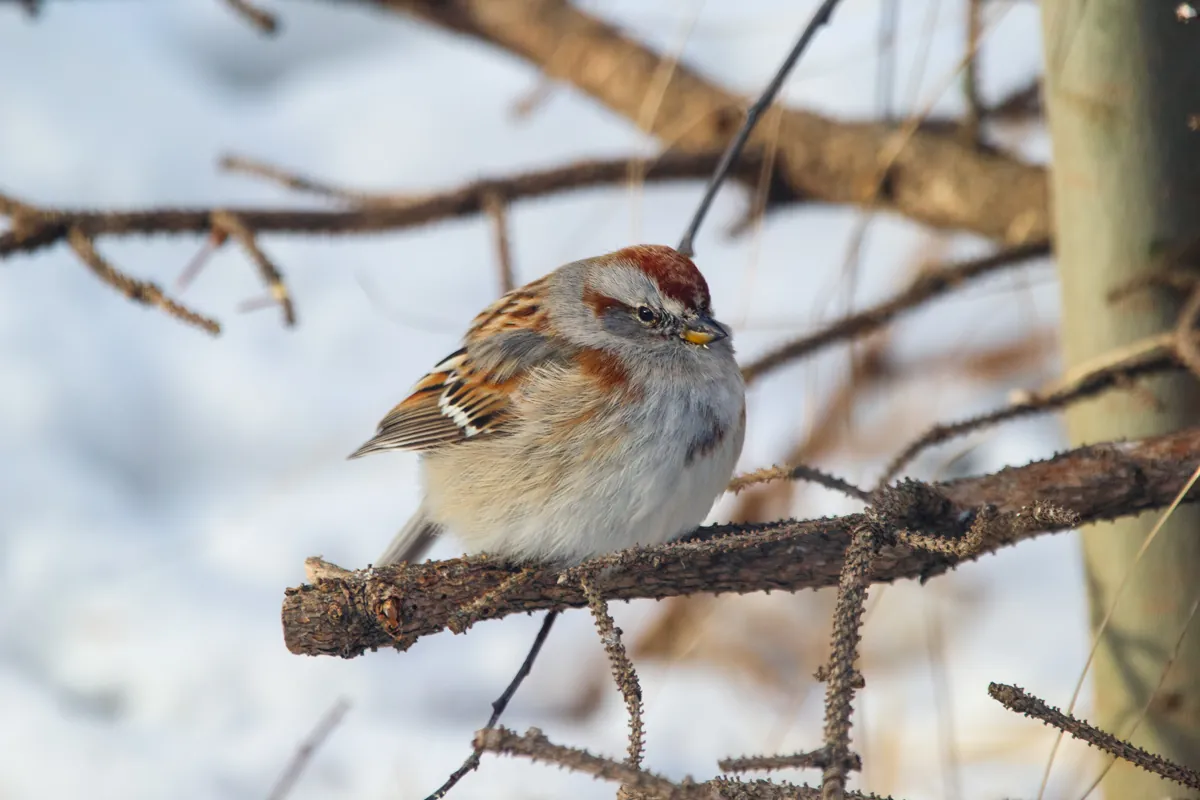
How to tell: three marks together. A rusty cap, a two-tone bill (dark on top, yellow below) and a plain gray breast with a single dark spot in the middle. The spot can be hidden when the bird is fluffed up, so check the bill too. The chipping sparrow is the lookalike: it has a black line through the eye instead of a rusty one, and no breast spot.
A few habits that make winter birding easier
- Go where the water is open. Eagles, ducks and gulls gather where it hasn't frozen.
- Look at the tops of things. Snags, poles and the crowns of junipers are where hawks, eagles and solitaires sit.
- Listen before you look. Fewer birds sing in winter, so the ones that do are easier to pick out.
- Give big birds room. An eagle or hawk that flies off because you got close burns energy it needs to get through a cold night. If it's watching you, you're close enough.
Keeping track of what you find
A notebook works fine. I built Biotadex, a free app, partly for walks like these: take a photo, or hold the phone up to listen for calls, and it suggests a name and adds the find to your own field guide. It does get lookalikes wrong sometimes, which is exactly why the field marks above still matter. And if you'd like your sightings to count toward bird science, eBird and iNaturalist are the places for that.
Happy looking. If you spot a rough-legged hawk hovering over a field this month, you've found one of the best winter birds in the state.
Sources
- Denver Audubon: Dark-eyed Junco
- Colorado Central Magazine: The Rough-legged Hawk
- Cornell Lab: Rough-legged Hawk, similar species
- National Park Service: Rough-legged Hawk
- Rocky Mountain National Park: Townsend's Solitaire
- Project FeederWatch: American Tree Sparrow and Chipping Sparrow
- Environment Colorado: Winter is bald eagle season in Colorado
- City of Fort Collins Natural Areas: Eagle Watch